Catherine Louisa Pirkis, The Experiences of Loveday Brooke, Lady Detective, 1894
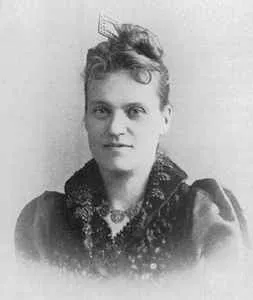 Catherine Louisa Pirkis (1839-1910)
First of all, Loveday Brooke is possibly the best name for a detective ever. Second of all, Loveday Brooke is the first female detective created by a female author, so that is pretty cool. Third of all, if you want to pick up a first edition of this book, one can be had for $4,000.
The Experiences of Loveday Brooke, Lady Detective was the last book by Pirkis, who began publishing mystery fiction in 1877. The book is a series of short stories originally published in The Ludgate Monthly. The stories are very much in the mold of Sherlock Holmes. Each begins with Loveday being briefed on the the fact of the case by Ebenezer Dyer, a private detective who relies on Loveday to crack the really hard cases. Amazingly, Dyer does not attempt to take credit for her victories and she is well-known in Britain for her detective work. Dyer describes Loveday as " one of the shrewdest and most clear-headed of my female detectives."
There are scholarly treatments of Loveday Brooke that unpack her meaning for feminism (see here or here). There is also a film in the making which is clearly 21st century in flavor and appears to be a "detective coming of age" story.
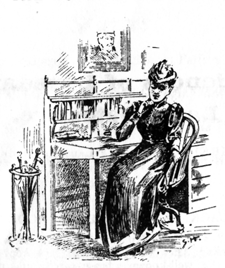 Loveday Brooke
Pirkis describes her detective thus:
Loveday Brooke, at this period of her career, was a little over thirty years of age, and could be best described in a series of negations.
She was not tall, she was not short; she was not dark, she was not fair; she was neither handsome nor ugly. Her features were altogether nondescript; her one noticeable trait was a habit she had, when absorbed in thought, of dropping her eyelids over her eyes till only a line of eyeball showed, and she appeared to be looking out at the world through a slit, instead of through a window.
Over thirty! Loveday is an absolute spinster! Will she ever get a husband? Pirkis answers the question by not even posing it. Just as the word spinster originally meant a woman of economic means, who had no need of a husband because she had a career spinning yarn, Loveday has a career which pays well and, as Shakespeare would say, cries "heigh-ho for husband."
One of the nice things about the stories is they lack the brilliant detective's hapless assistant and we are spared the detective giving opaque clues to the assistant and refusing to explain them. On the other hand, that means all the explanations for solving the mystery are saved until the last pages when Loveday explains the solution. Mystery purists might object that too many key clues are never revealed until this explanation. It didn't bother me, I can never figure out whodunit no matter how may clues are given to me. I'd make a great hapless assistant.
Free ebook: https://www.gutenberg.net.au/ebooks13/1302211h.html
There is no free audiobook of the entire book, but you can get very nice versions of each story:
- "The Black Bag Left on a Doorstep" https://youtu.be/3cO99R4UDVA?si=I7PzU6MyNxKmvKto
- "Murder at Troyte Hill," CBS Radio Drama https://youtu.be/V5-Jey4mMQE?si=eAnsDhxhA_STaI7s
- "The Redhill Sisterhood," https://youtu.be/A6fRPhnRZFs?si=upf6lun963bFF4kG
- "Princess's vengeance" https://youtu.be/6SzVdDnNSlo?si=zsf9KelO4FEtcnci
- "Drawn Daggers" https://youtu.be/8TdTQ91B-Jc?si=hWWlmSuX-8gB2ZH1
- "Ghost of Fountain Lane" https://youtu.be/GuFZUobcs6E?si=9bz-lMBdgkThQO2d
- "Missing" https://youtu.be/qZQml_90xrU?si=v_UG-xBBL_yET_WF
Reading Gutenberg by John Jackson is licensed under CC BY-SA 4.0

