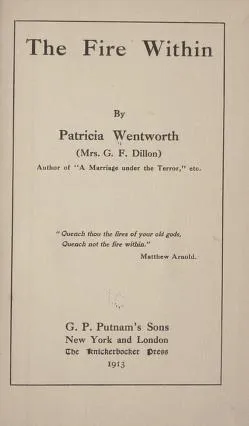
Patricia Wentworth, The Fire Within, 1913
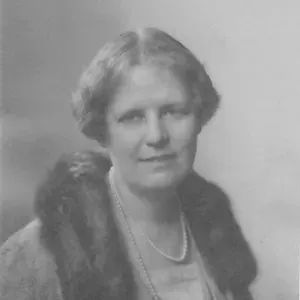 Patricia Wentworth (1877-1961)
Patricia Wentworth was the pen name of Dora Amy Turnbull (formerly Dillon, née Elles) who wrote 69 novels. Before Agatha Christie gave us Miss Marple, Wentworth gave us Miss Silver, professional detective who starred in 32 of Wentworth's books. Wentworth also wrote of other detectives each of which had their own series of books. So when I chose the stand-alone novel The Fire Within I thought it would be a whodunit-type crime novel.
The novel begins with a mysterious poisoning. Aha! We are off and running! Someone is guilty of... MURDER! The death is quickly followed by a pact of silence among our main characters which requires the attending physician to not report his findings of arsenic poisoning. No good can come of this! "The poisoner will be caught," I thought, "as is required in all detective novels, even in 1913! What twists and turns await!" Soon a letter arrives which seems to solve the mystery even if it does so in way that doesn't please all of our main characters. "Oh ho!" I thought, "A false flag that will soon be uncovered by someone pulling a loose thread and the entirety of the murderer's scheme will be unraveled! How will it be done, I wonder?"
I've never claimed to be quick on the uptake. Rather than a murder mystery, this book is a superb account of the psychological damage done by a pact of silence enforced by unrequited love. We follow several characters as they struggle with their own choices which leads to, in the parlance of the time, "madness." Wentworth portrays the fears of her characters with a chilling and poetic effect.
I have a special love of fiction that portrays adult siblings and their relationship with each other. There is something special about two adults who grew up together who love each other but also can speak to each other in ways that would never be tolerated by anyone else. Consider this snippet of dialogue between the wonderfully-named Agneta and Louis Mainwaring:
Agneta tossed her head.
“Oh, I don’t suppose there’ll be any letters in heaven,” she said. “I’m sure I trust not. My idea is that we shall sit on nice comfy clouds, and play at telephones with thought-waves.”
Louis shut his book with a bang.
“Really, Agneta, if that isn’t materialism.” He came over and sat down on the hearth-rug beside his sister. They were not at all alike. Where Agneta was small, Louis was large. Her hair and eyes were black, and his of a dark reddish-brown.
“I didn’t know you were listening,” she said.
“Well, I wasn’t. I just heard, and I give you fair warning, Agneta, that if there are going to be telephones in your heaven, I’m going somewhere else. I shall have had enough of them here. Hear the bells, the silver bells, the tintinabulation that so musically swells. From the bells, bells, bells, bells—bells, bells, bells.”
Agneta first pulled Louis’s hair, and then put her fingers in her ears.
“Stop! stop this minute! Oh, Louis, please. Oh, Lizabeth, make him stop. That thing always drives me perfectly crazy, and he knows it.”
“All right. It’s done. I’ve finished. I’m much more merciful than Poe. I only wanted to point out that if that was your idea of heaven, it wasn’t mine.”
Mystery buffs sometimes bemoan the fact that Wentworth is not as well-known as Christie. Maybe it is time to read more Wentworth!
Free ebook: https://gutenberg.org/ebooks/62820
Reading Gutenberg by John Jackson is licensed under CC BY-SA 4.0

