Vernon Lee, Hauntings, 1890
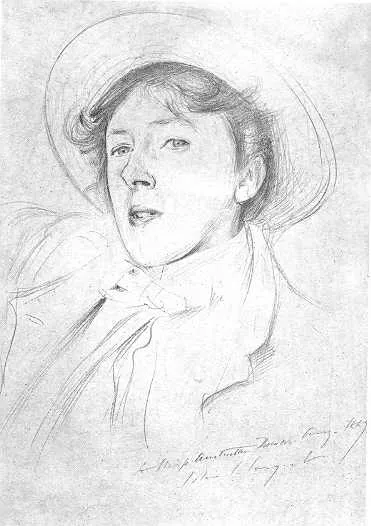 Violet Paget, aka Vernon Lee
Vernon Lee was the pen name of Violet Paget (1896-1935), a 19th century feminist, lesbian, pacifist, and philosopher. In addition to writing what was then called "supernatural fiction," Paget wrote on aesthetics and was an important advocate for the "aesthetic movement," which taught that art should exist for the sake of beauty and no other further justification for it was necessary. A painting had no obligation to tell a story or teach a lesson, beauty was enough.
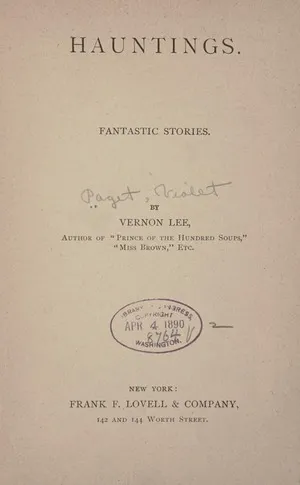
In Hauntings: Fantastic Stories, Paget's stories reflect her devotion to the aesthetic movement; they are filled with rich descriptions of people and places. Her style reminds me of Mervyn Peake, himself a talented illustrator, both in its fantastic nature and in the evocative descriptions of the characters and landscapes. For Paget, plot can wait as she describes the scenes and settings of her story. In the first of the four stories that make up this volume, "Amour Dure: Passages from the Diary of Spiridion Trepka," we follow a young historian and art critic to Italy for his research:
I take refuge in long rambles through the town. This town is a handful of tall black houses huddled on to the top of an Alp, long narrow lanes trickling down its sides, like the slides we made on hillocks in our boyhood, and in the middle the superb red brick structure, turreted and battlemented, of Duke Ottobuono’s palace, from whose windows you look down upon a sea, a kind of whirlpool, of melancholy grey mountains. Then there are the people, dark, bushy-bearded men, riding about like brigands, wrapped in green-lined cloaks upon their shaggy pack-mules; or loitering about, great, brawny, low-headed youngsters, like the parti-colored bravos in Signorelli’s frescoes; the beautiful boys, like so many young Raphaels, with eyes like the eyes of bullocks, and the huge women, Madonnas or St. Elizabeths, as the case may be, with their clogs firmly poised on their toes and their brass pitchers on their heads, as they go up and down the steep black alleys.
The pacing of the stories is important. These stories unfold slowly leaving the reader to wonder if the narrator (the stories are all written in the first person) is slowly going mad or if the increasingly strange things being described are actually happening. Is the narrator really falling in love with the ghost of a woman long dead? Is the strange and mysterious woman taken into a sleepy fishing village a witch or goddess? Is the hostess of our narrator the reincarnation of a murderer dead these two centuries? The common theme is obsession: the narrators relentlessly pursue what we, the readers, can see is a doomed confrontation with some supernatural force. But the narrators themselves are pursuing their own death because they can do no other.
In the opening paragraphs of "Oke of Okehurst," the narrator write to his correspondent, "You thought it a fantastic tale, you lover of fantastic things, and urged me to write it out at once, although I protested that, in such matters, to write is to exorcise, to dispel the charm; and that printers’ ink chases away the ghosts that may pleasantly haunt us, as efficaciously as gallons of holy water." The book itself shows this sentence to be untrue as these stories are as strange and haunted as any ghost story could possibly be.
Free ebook:https://www.gutenberg.org/ebooks/9956
Free audiobook: https://librivox.org/hauntings-by-vernon-lee/
Reading Gutenberg by John Jackson is licensed under CC BY-SA 4.0

